


Page 36 - IB January 2022
P. 36
Sport and Fitness                                                                                                                                                                              Sport and Fitness


                      HASHING FOR FUN, WELL-BEING


                                            AND HARMONY


                                                                   By Jason Jett

                                                                     “…You don’t know where you’re going, and where this ad-
                                                                   venture will lead you.”
                                                                     “There is no racism in hash,” said David Jamieson, owner of
                                                                   Yacht Help Fiji, while welcoming into the fold this new hasher
                                                                   in Nadi, Fiji last March. “In hash, everyone is equal.”
                                                                     An African-American writer stranded by the pandemic in
                                                                   Fiji, I am very familiar with racism – a stain on the very fabric
                                                                   of society in the United States.
                                                                      Overhearing the conversation, an Aussie expat interjected,
                                                                   “Australia is a pretty racist country, I admit.” He then asked a
                                                                   nearby hasher, “Is there racism in Scotland?”
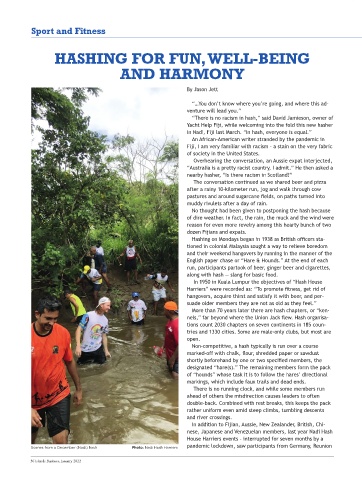
                                                                      The conversation continued as we shared beer and pizza
                                                                   after a rainy 10-kilometer run, jog and walk through cow
                                                                   pastures and around sugarcane fields, on paths turned into
                                                                   muddy rivulets after a day of rain.
                                                                     No thought had been given to postponing the hash because
                                                                   of dire weather. In fact, the rain, the muck and the wind were
                                                                   reason for even more revelry among this hearty bunch of two
                                                                   dozen Fijians and expats.
                                                                     Hashing on Mondays began in 1938 as British officers sta-
                                                                   tioned in colonial Malaysia sought a way to relieve boredom
                                                                   and their weekend hangovers by running in the manner of the
                                                                   English paper chase or “Hare & Hounds.” At the end of each
                                                                   run, participants partook of beer, ginger beer and cigarettes,
                                                                   along with hash — slang for basic food.
                                                                      In 1950 in Kuala Lumpur the objectives of “Hash House
                                                                   Harriers” were recorded as: “To promote fitness, get rid of
                                                                   hangovers, acquire thirst and satisfy it with beer, and per-
                                                                   suade older members they are not as old as they feel.”
                                                                     More than 70 years later there are hash chapters, or “ken-
                                                                   nels,” far beyond where the Union Jack flew. Hash organisa-
                                                                   tions count 2030 chapters on seven continents in 185 coun-
                                                                   tries and 1330 cities. Some are male-only clubs, but most are
                                                                   open.
                                                                     Non-competitive, a hash typically is run over a course
                                                                   marked-off with chalk, flour, shredded paper or sawdust
                                                                   shortly beforehand by one or two specified members, the
                                                                   designated “hare(s).” The remaining members form the pack
                                                                   of “hounds” whose task it is to follow the hares’ directional
                                                                   markings, which include faux trails and dead ends.
                                                                      There is no running clock, and while some members run
                                                                   ahead of others the misdirection causes leaders to often
                                                                   double-back. Combined with rest breaks, this keeps the pack
                                                                   rather uniform even amid steep climbs, tumbling descents
                                                                   and river crossings.
                                                                     In addition to Fijian, Aussie, New Zealander, British, Chi-
                                                                   nese, Japanese and Venezuelan members, last year Nadi Hash
                                                                   House Harriers events – interrupted for seven months by a
              Scenes from a December (Nadi) hash   Photo: Nadi Hash Harriers  pandemic lockdown, saw participants from Germany, Reunion

              36 Islands Business, January 2022

