


Page 33 - IB January 2022
P. 33
Climate Change                                                                            Climate Change


               Overall, the report argues that US global security interests
             will be challenged, because adverse climate impacts are felt
             most in poor, developing nations: “Scientific forecasts indicate
             that intensifying physical effects of climate change out to 2040
             and beyond will be most acutely felt in developing countries,
             which we assess are also the least able to adapt to such
             changes. These physical effects will increase the potential for
             instability and possibly internal conflict in these countries,
             in some cases creating additional demands on US diplomatic,
             economic, humanitarian, and military resources.”

               Australia and New Zealand step up
               For many years, the Australia and New Zealand governments
             have been reluctant to integrate climate change into their
             strategic and security policies, but are now slowly beginning to
             follow the lead of their larger ANZUS partner.
               In Nauru in 2018, the Pacific Islands Forum adopted the Boe
             Declaration which states that, amongst many transnational se-
             curity challenges, “climate change remains the single greatest
             threat to the livelihoods, security and wellbeing of the peoples
             of the Pacific.”
               ANZUS defence and security agencies are now grappling with
             this focus on climate change rather than China as the region’s
             central security threat. There’s a long way to go, however,
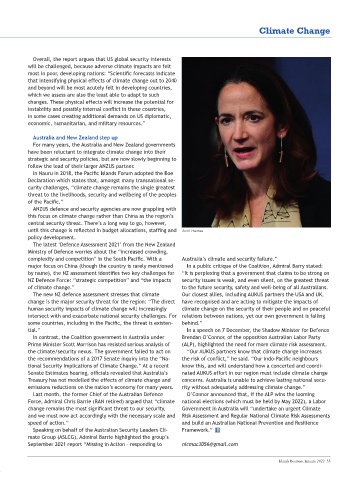
             until this change is reflected in budget allocations, staffing and   Avril Haines
             policy development.                                                                                              {
               The latest ‘Defence Assessment 2021’ from the New Zealand
             Ministry of Defence worries about the “increased crowding,
             complexity and competition” in the South Pacific. With a   Australia’s climate and security failure.”
             major focus on China (though the country is rarely mentioned   In a public critique of the Coalition, Admiral Barry stated:
             by name), the NZ assessment identifies two key challenges for   “It is perplexing that a government that claims to be strong on
             NZ Defence Force: “strategic competition” and “the impacts   security issues is weak, and even silent, on the greatest threat
             of climate change.”                                 to the future security, safety and well-being of all Australians.
               The new NZ defence assessment stresses that climate   Our closest allies, including AUKUS partners the USA and UK,
             change is the major security threat for the region: “The direct  have recognised and are acting to mitigate the impacts of
             human security impacts of climate change will increasingly   climate change on the security of their people and on peaceful
             intersect with and exacerbate national security challenges. For  relations between nations, yet our own government is falling
             some countries, including in the Pacific, the threat is existen-  behind.”
             tial.”                                                In a speech on 7 December, the Shadow Minister for Defence
               In contrast, the Coalition government in Australia under   Brendan O’Connor, of the opposition Australian Labor Party
             Prime Minister Scott Morrison has resisted serious analysis of   (ALP), highlighted the need for more climate risk assessment.
             the climate/security nexus. The government failed to act on   “Our AUKUS partners know that climate change increases
             the recommendations of a 2017 Senate inquiry into the “Na-  the risk of conflict,” he said. “Our Indo-Pacific neighbours
             tional Security Implications of Climate Change.” At a recent   know this, and will understand how a concerted and coordi-
             Senate Estimates hearing, officials revealed that Australia’s   nated AUKUS effort in our region must include climate change
             Treasury has not modelled the effects of climate change and   concerns. Australia is unable to achieve lasting national secu-
             emissions reductions on the nation’s economy for many years.  rity without adequately addressing climate change.”
               Last month, the former Chief of the Australian Defence   O’Connor announced that, if the ALP wins the looming
             Force, Admiral Chris Barrie (RAN retired) argued that “climate   national elections (which must be held by May 2022), a Labor
             change remains the most significant threat to our security,   Government in Australia will “undertake an urgent Climate
             and we must now act accordingly with the necessary scale and  Risk Assessment and Regular National Climate Risk Assessments
             speed of action.”                                   and build an Australian National Prevention and Resilience
               Speaking on behalf of the Australian Security Leaders Cli-  Framework.”
             mate Group (ASLCG), Admiral Barrie highlighted the group’s
             September 2021 report “Missing in Action – responding to   nicmac3056@gmail.com

                                                                                                  Islands Business, January 2022  33

