


Page 5 - IB January 2022
P. 5
People


                          REMEMBERING DR BRIJ LAL


             By Iva Tora

               In 2021, Fiji farewelled one of its most pre-eminent schol-
             ars and a vocal critic of Fiji’s militarised government, the
             historian Emeritus professor, Brij Vilash Lal.
               Prof Brij Vilash Lal died in exile in Brisbane on Christmas
             Day after having been banned for life from his homeland in
             2009 by Frank Bainimarama.
               Brij Lal had had an extraordinary rise from the sugar cane
             fields of Tabia, a village near Labasa town in Fiji’s second
             largest island – Vanua Levu - to serving with academic distinc-
             tion and honours with the world’s leading universities.
               The descendant of indentured labourers or Girmitiya, Lal
             was born on 21 August 1952. His early, rudimentary education
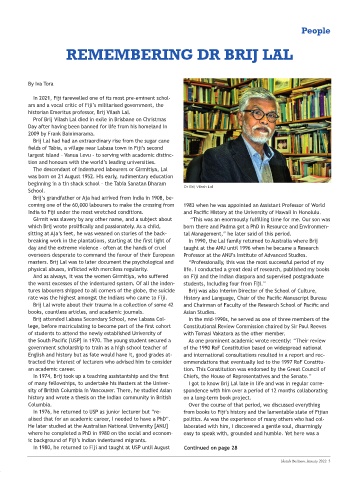
             beginning in a tin shack school – the Tabia Sanatan Dharam   Dr Brij Vilash Lal
             School.
               Brij’s grandfather or Aja had arrived from India in 1908, be-
             coming one of the 60,000 labourers to make the crossing from   1983 when he was appointed an Assistant Professor of World
             India to Fiji under the most wretched conditions.    and Pacific History at the University of Hawaii in Honolulu.
               Girmit was slavery by any other name, and a subject about    “This was an enormously fulfilling time for me. Our son was
             which Brij wrote prolifically and passionately. As a child,   born there and Padma got a PhD in Resource and Environmen-
             sitting at Aja’s feet, he was weaned on stories of the back-  tal Management,” he later said of this period.
             breaking work in the plantations, starting at the first light of   In 1990, the Lal family returned to Australia where Brij
             day and the extreme violence – often at the hands of cruel   taught at the ANU until 1996 when he became a Research
             overseers desperate to command the favour of their European   Professor at the ANU’s Institute of Advanced Studies.
             masters. Brij Lal was to later document the psychological and   “Professionally, this was the most successful period of my
             physical abuses, inflicted with merciless regularity.   life. I conducted a great deal of research, published my books
               And as always, it was the women Girmitiya, who suffered   on Fiji and the Indian diaspora and supervised postgraduate
             the worst excesses of the indentured system. Of all the inden-  students, including four from Fiji.”
             tures labourers shipped to all corners of the globe, the suicide   Brij was also Interim Director of the School of Culture,
             rate was the highest amongst the Indians who came to Fiji.  History and Language, Chair of the Pacific Manuscript Bureau
               Brij Lal wrote about their trauma in a collection of some 42   and Chairman of Faculty of the Research School of Pacific and
             books, countless articles, and academic journals.    Asian Studies.
               Brij attended Labasa Secondary School, now Labasa Col-  In the mid-1990s, he served as one of three members of the
             lege, before matriculating to become part of the first cohort   Constitutional Review Commission chaired by Sir Paul Reeves
             of students to attend the newly established University of   with Tomasi Vakatora as the other member.
             the South Pacific [USP] in 1970. The young student secured a   As one prominent academic wrote recently: “Their review
             government scholarship to train as a high school teacher of   of the 1990 RoF Constitution based on widespread national
             English and history but as fate would have it, good grades at-  and international consultations resulted in a report and rec-
             tracted the interest of lecturers who advised him to consider   ommendations that eventually led to the 1997 RoF Constitu-
             an academic career.                                  tion. This Constitution was endorsed by the Great Council of
               In 1974, Brij took up a teaching assistantship and the first   Chiefs, the House of Representatives and the Senate.”
             of many fellowships, to undertake his Masters at the Univer-  I got to know Brij Lal late in life and was in regular corre-
             sity of British Columbia in Vancouver. There, he studied Asian   spondence with him over a period of 12 months collaborating
             history and wrote a thesis on the Indian community in British   on a long-term book project.
             Columbia.                                             Over the course of that period, we discussed everything
               In 1976, he returned to USP as junior lecturer but “re-  from books to Fiji’s history and the lamentable state of Fijian
             alised that for an academic career, I needed to have a PhD”.   politics. As was the experience of many others who had col-
             He later studied at the Australian National University [ANU]   laborated with him, I discovered a gentle soul, disarmingly
             where he completed a PhD in 1980 on the social and econom-  easy to speak with, grounded and humble. Yet here was a
             ic background of Fiji’s Indian indentured migrants.
               In 1980, he returned to Fiji and taught at USP until August   Continued on page 28

                                                                                                   Islands Business, January 2022  5

