


Page 25 - IB January 2022
P. 25
Education                                                                                          Education


                    THE CLASSROOM OF THE FUTURE

                                 MAY BE TRULY GLOBAL


             By Yong Zhao, University of Kansas                   problems, students must work with each other. And in the age
                                                                  of global learning, students can collaborate with students in
               School education has for a long time been one size fits all,   other schools, other states, or other countries. This global col-
             criticised for its inability to meet the needs of all students.   laboration makes it possible for students to learn from, with,
             Reform measures have generally failed to improve learning in   and for others on a global scale.
             even the most basic subjects of math and reading. Students   This doesn’t mean local schools are unnecessary. Schools
             have often been left out of attempts to improve.     deliver vital in-person contact and interactions with peers and
               Then COVID-19 happened. School closures forced the entire   adults, where students can get guidance and support in their
             industry to create new ways of teaching and learning. Caught   pursuit of strengths and passions. More importantly, students
             in the chaos, students, teachers, administrators, policymak-  need a local community to learn how their unique talents and
             ers and parents all had to adjust, inventing new policies and   strong interests can be of value to others.
             practices in just days.                                Personalisation of learning requires schools to be flexible
               Not surprisingly, results varied. With the disruption came   with curriculum, student organisation, and teacher instruc-
             the possibility for schools to rethink education. All teachers   tion.
             and students have now experienced remote learning, the   Modern schools could divide curriculum into three parts:
             resources to support it have grown and new more innovative   national and state common courses for all students, school
             ways of teaching and learning have emerged.          specific courses for all students, and personalised learning for
               Many schools have been eager to return to ‘normal’ but   individual students.
             normal no longer exists.                               Schools can also be flexible with how students are organ-
               Out of the disruption could come more personalised learn-  ised, without necessarily placing all students into subject-
             ing. Learning that is strengths-based and passion-driven, with   matter based classes based on biological age.
             students at the centre.                                And teachers could be encouraged to change their roles
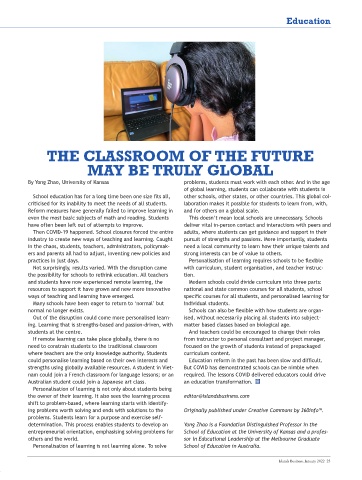
               If remote learning can take place globally, there is no   from instructor to personal consultant and project manager,
             need to constrain students to the traditional classroom   focused on the growth of students instead of prepackaged
             where teachers are the only knowledge authority. Students   curriculum content.
             could personalise learning based on their own interests and   Education reform in the past has been slow and difficult.
             strengths using globally available resources. A student in Viet-  But COVID has demonstrated schools can be nimble when
             nam could join a French classroom for language lessons; or an   required. The lessons COVID delivered educators could drive
             Australian student could join a Japanese art class.   an education transformation.
               Personalisation of learning is not only about students being
             the owner of their learning. It also sees the learning process   editor@islandsbusiness.com
             shift to problem-based, where learning starts with identify-
             ing problems worth solving and ends with solutions to the   Originally published under Creative Commons by 360info™.
             problems. Students learn for a purpose and exercise self-
             determination. This process enables students to develop an   Yong Zhao is a Foundation Distinguished Professor in the
             entrepreneurial orientation, emphasising solving problems for   School of Education at the University of Kansas and a profes-
             others and the world.                                sor in Educational Leadership at the Melbourne Graduate
               Personalisation of learning is not learning alone. To solve   School of Education in Australia.

                                                                                                  Islands Business, January 2022  25

