


Page 23 - Islands Business January 2021
P. 23
Comment


                            BRAWN BUT NO BRAINS?


        By Retired Captain Savenaca Kadavi


          A couple of years ago, a Fijian who had been engaged as
        deck crew on a tuna longliner was ‘offloaded’ in Hong Kong;
        he knew no-one there and had little money.
          Why was that action taken? Was he lazy, or ate ‘too much’,
        got sick, attacked the other crew, or? No. The reason was
        that he knew his rights and kept asking for them. Things like
        decent food and adequate rest time. He was a bother to the
        captain.
          One fishing company representative recently confirmed to
        us what I’d been told by community members living adjacent
        to fishing company premises — that particular companies
        sometimes are so in need of deck crew that they send a
        driver into the settlements or along adjacent roads, looking
        for youngish (and brawny) men to work as deck crew.  “Hey
        Boso - Want a job?”
          Barring a few exceptions most 18 to 40-year-old men in
        coastal Suva settlement communities work as deck crew on
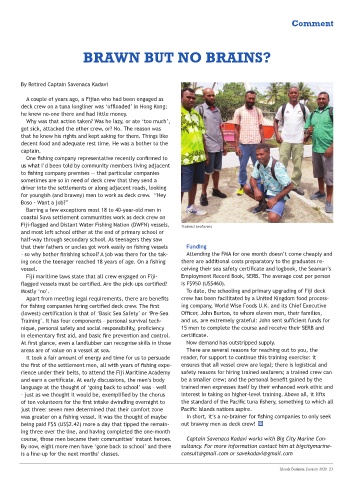
        Fiji-flagged and Distant Water Fishing Nation (DWFN) vessels,   Trained seafarers
        and most left school either at the end of primary school or
        half-way through secondary school. As teenagers they saw
        that their fathers or uncles got work easily on fishing vessels   Funding
        – so why bother finishing school? A job was there for the tak-  Attending the FMA for one month doesn’t come cheaply and
        ing once the teenager reached 18 years of age. On a fishing   there are additional costs preparatory to the graduates re-
        vessel.                                             ceiving their sea safety certificate and logbook, the Seaman’s
          Fiji maritime laws state that all crew engaged on Fiji-  Employment Record Book, SERB. The average cost per person
        flagged vessels must be certified. Are the pick-ups certified?   is F$950 (US$460).
        Mostly ‘no’.                                          To date, the schooling and primary upgrading of Fiji deck
          Apart from meeting legal requirements, there are benefits   crew has been facilitated by a United Kingdom food process-
        for fishing companies hiring certified deck crew. The first   ing company, World Wise Foods U.K. and its Chief Executive
        (lowest) certification is that of ‘Basic Sea Safety’ or ‘Pre-Sea   Officer, John Burton, to whom eleven men, their families,
        Training’. It has four components – personal survival tech-  and us, are extremely grateful: John sent sufficient funds for
        nique, personal safety and social responsibility, proficiency   15 men to complete the course and receive their SERB and
        in elementary first aid, and basic fire prevention and control.   certificate.
        At first glance, even a landlubber can recognise skills in those   Now demand has outstripped supply.
        areas are of value on a vessel at sea.                There are several reasons for reaching out to you, the
          It took a fair amount of energy and time for us to persuade   reader, for support to continue this training exercise: it
        the first of the settlement men, all with years of fishing expe-  ensures that all vessel crew are legal; there is logistical and
        rience under their belts, to attend the Fiji Maritime Academy   safety reasons for hiring trained seafarers; a trained crew can
        and earn a certificate. At early discussions, the men’s body   be a smaller crew; and the personal benefit gained by the
        language at the thought of ‘going back to school’ was – well   trained men expresses itself by their enhanced work ethic and
        – just as we thought it would be, exemplified by the chorus   interest in taking on higher-level training. Above all, it lifts
        of ten volunteers for the first intake dwindling overnight to   the standard of the Pacific tuna fishery, something to which all
        just three: seven men determined that their comfort zone   Pacific Islands nations aspire.
        was greater on a fishing vessel. It was the thought of maybe   In short, it’s a no-brainer for fishing companies to only seek
        being paid F$5 (US$2.42) more a day that tipped the remain-  out brawny men as deck crew!
        ing three over the line, and having completed the one-month
        course, those men became their communities’ instant heroes.   Captain Savenaca Kadavi works with Big City Marine Con-
        By now, eight more men have ‘gone back to school’ and there   sultancy. For more information contact him at bigcitymarine-
        is a line-up for the next months’ classes.          consult@gmail.com or savekadavi@gmail.com

                                                                                            Islands Business, January 2021  23

