


Page 13 - Islands Business January 2021
P. 13
Cover                                                                                               Cover

                                                            Panuelo described the dilemma leaders face in the case of
                                                            stranded citizens when he said: “I authorised the Chief Mailo
                                                            to return home to the FSM because the Government was
                                                            faced with two choices. The ship’s crew were already at the
                                                            minimum operation requirement, and some of the crew were
                                                            saying that they would leave the ship to either stay in the
                                                            Philippines or see their families stranded in Guam. So, I could
                                                            either abandon the ship the National Government uses to
                                                            serve the State of Chuuk, and leave its crew and the 12-year-
                                                            old boy from Polowat [the sole survivor of a drifting event]
                                                            outside of our care, or I could bring them home…I chose to
                                                            bring them home. I could not abandon our citizens, and I
                                                            could not abandon a 12-year-old child…I take full responsibil-
                                                            ity for this choice.”
                                                              The Pacific has not been immune to the spread of specula-
                                                            tion and misinformation over COVID-19, and providing clear
                                                            and timely information as the vaccines are rolled out will be
                                                            critical. There is much to learn from what did and did not
                                                            work in terms of our health systems and communications last
                                                            year.

                                                              The economic outlook
                                                              As a region, Pacific Island GDP growth was forecast to shrink
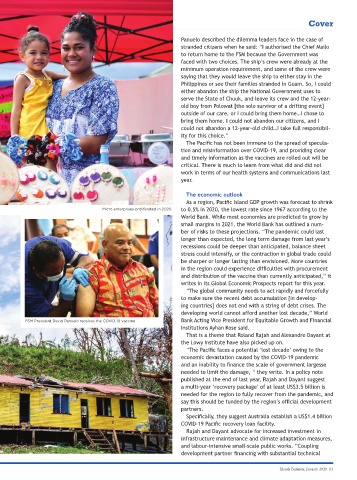
                                  Micro enterprises proliferated in 2020.  to 0.5% in 2020, the lowest rate since 1967 according to the
                                                            World Bank. While most economies are predicted to grow by
                                                            small margins in 2021, the World Bank has outlined a num-
                                                            ber of risks to these projections. “The pandemic could last
                                                            longer than expected, the long term damage from last year’s
                                                            recessions could be deeper than anticipated, balance sheet
                                                            stress could intensify, or the contraction in global trade could
                                                            be sharper or longer lasting than envisioned. More countries
                                                            in the region could experience difficulties with procurement
                                                            and distribution of the vaccine than currently anticipated,” it
                                                            writes in its Global Economic Prospects report for this year.
                                                              “The global community needs to act rapidly and forcefully
                                                            to make sure the recent debt accumulation [in develop-
                                                            ing countries] does not end with a string of debt crises. The
                                                            developing world cannot afford another lost decade,” World
         FSM President David Panuelo receives the COVID-19 vaccine  Bank Acting Vice President for Equitable Growth and Financial
                                                            Institutions Ayhan Kose said.
                                                              That is a theme that Roland Rajah and Alexandre Dayant at
                                                            the Lowy Institute have also picked up on.
                                                              “The Pacific faces a potential ‘lost decade’ owing to the
                                                            economic devastation caused by the COVID-19 pandemic
                                                            and an inability to finance the scale of government largesse
                                                            needed to limit the damage, “ they write. In a policy note
                                                            published at the end of last year, Rajah and Dayant suggest
                                                            a multi-year ‘recovery package’ of at least US$3.5 billion is
                                                            needed for the region to fully recover from the pandemic, and
                                                            say this should be funded by the region’s official development
                                                            partners.
                                                              Specifically, they suggest Australia establish a US$1.4 billion
                                                            COVID-19 Pacific recovery loan facility.
                                                              Rajah and Dayant advocate for increased investment in
                                                            infrastructure maintenance and climate adaptation measures,
                                                            and labour-intensive small-scale public works. “Coupling
                                                            development partner financing with substantial technical


                                                                                            Islands Business, January 2021  13

